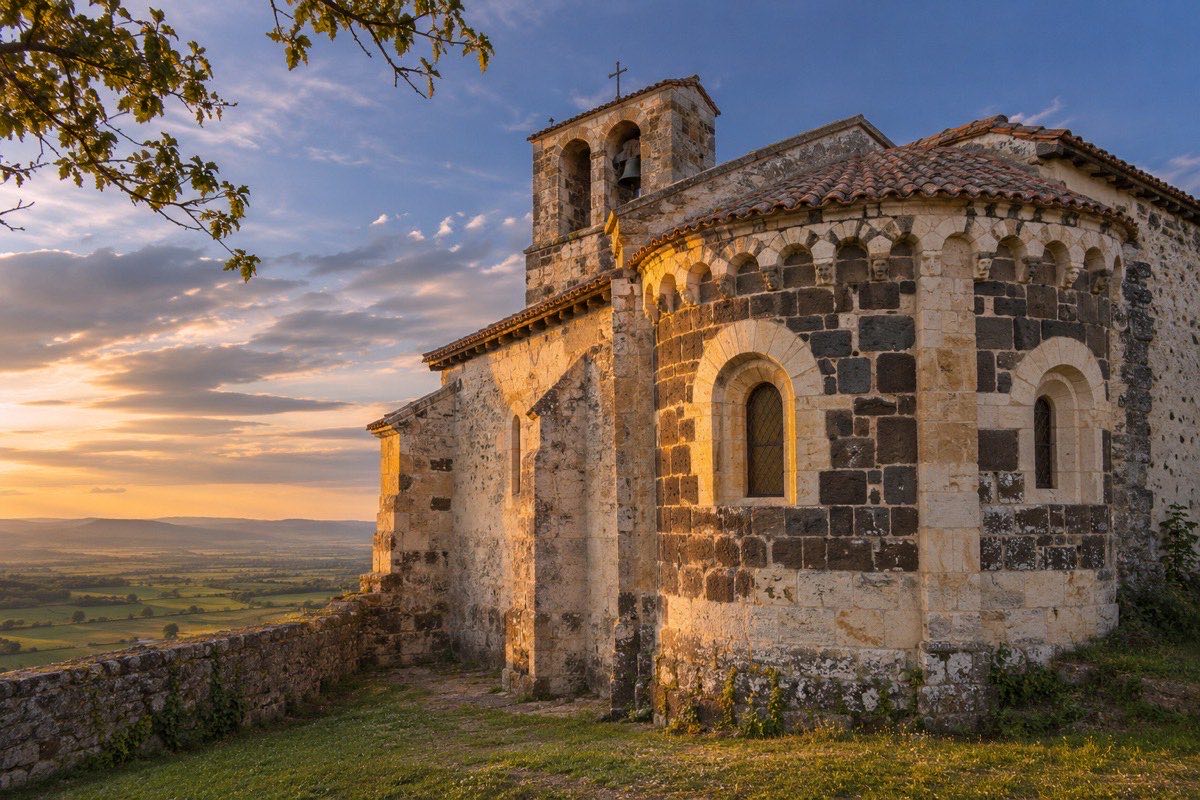
Folio 01
What is a priory
What is a priory, who leads it and how it differs from an abbey: conventual and dependent priories, the Cluniac model and what makes a church a priory church.
Read the guide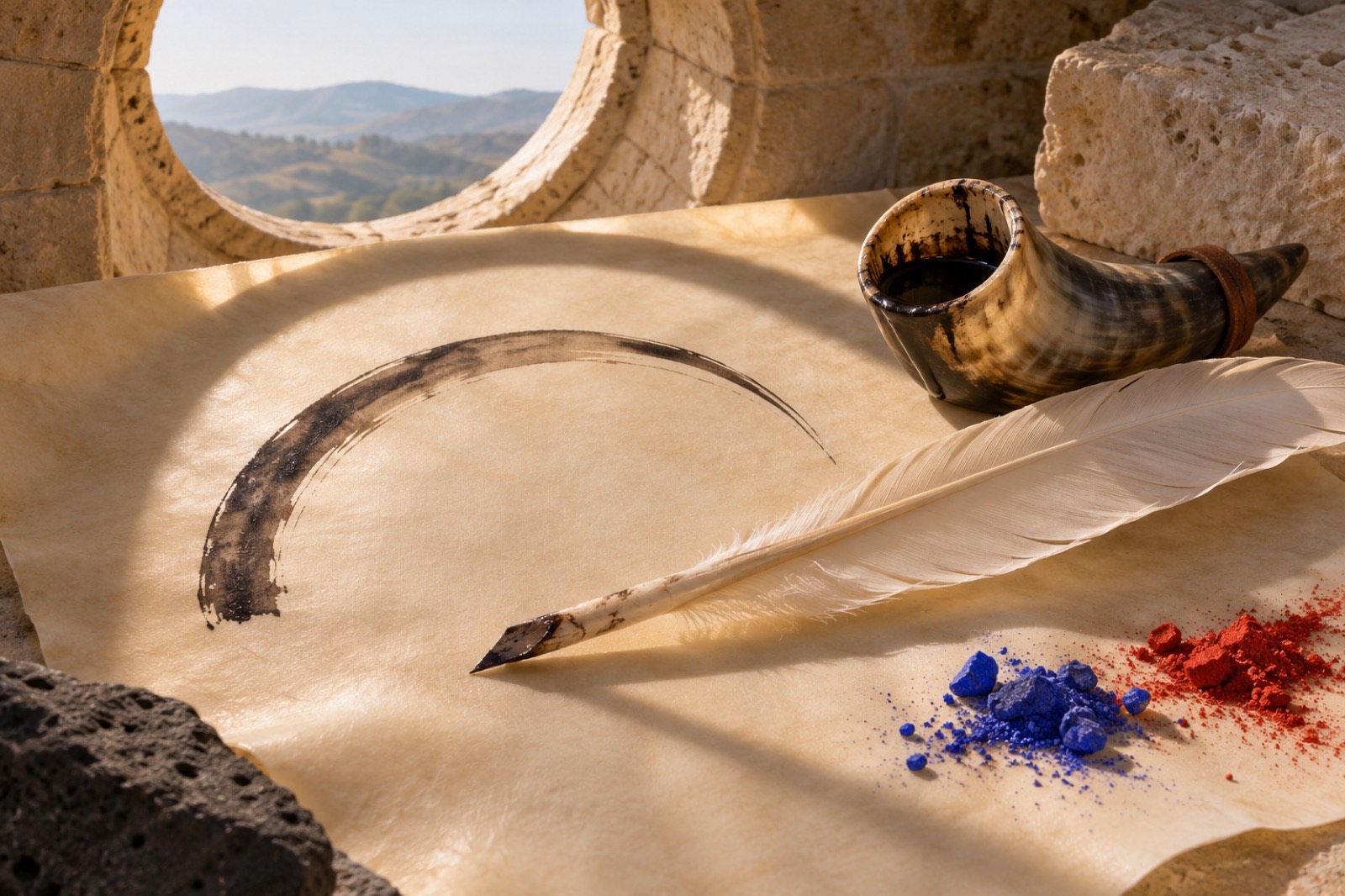
Priories, Romanesque churches and Western calligraphy
Romanesque architecture in France is the main subject of Vault & Vellum, our independent information site on Romanesque priories, religious architecture and the history of manuscripts. We explore the buildings and the books made within their walls.
I
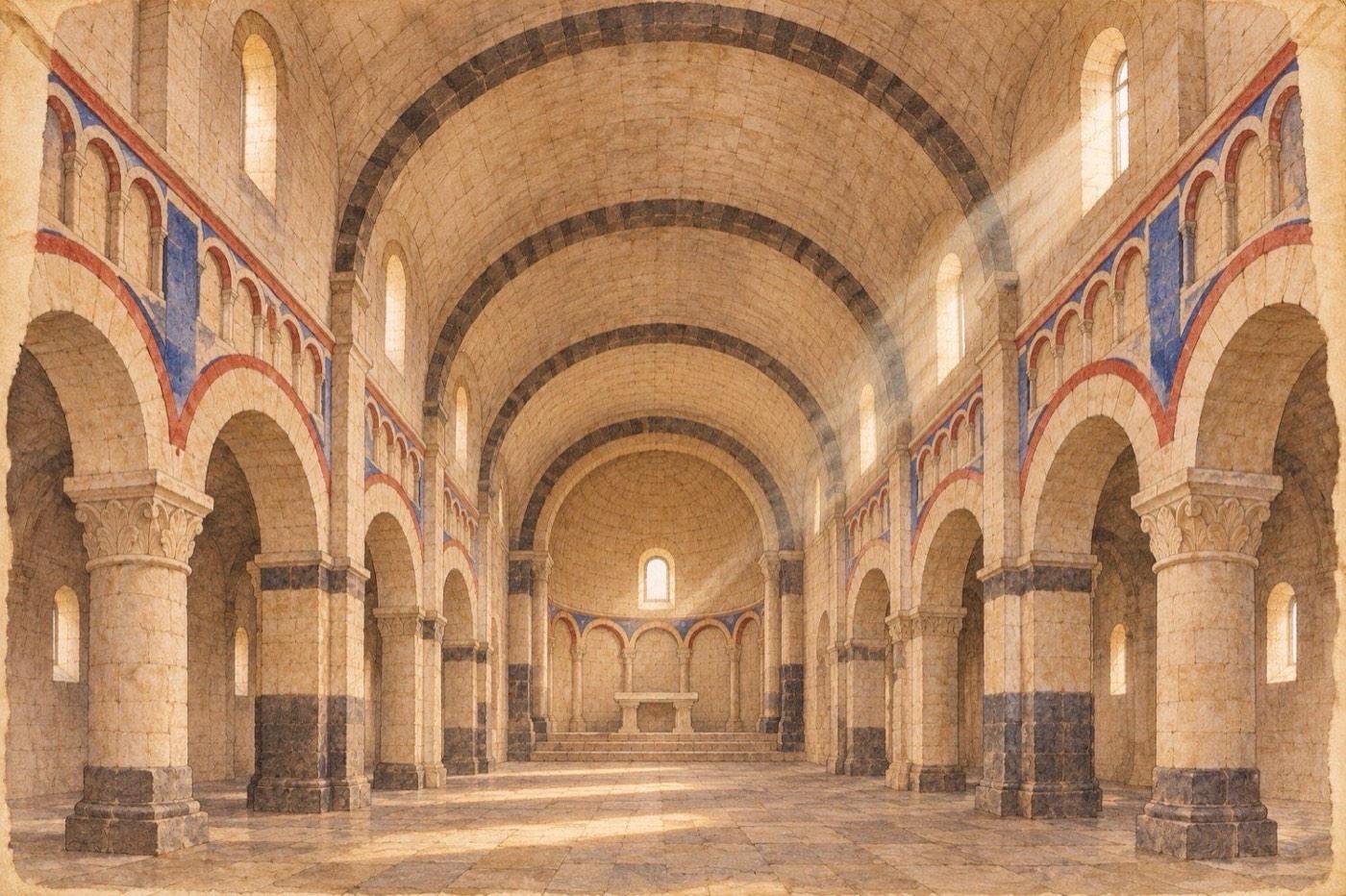
Romanesque walls are massive, often double shells filled with rubble, with few and fairly small openings. The wall, not the column, carries the load.
II
Doors, windows, arcades and vaults are nearly always semicircular. Two arched windows paired under a larger arch are a typical motif.
III
The simplest stone roof is the barrel vault, one arched surface from wall to wall. Two barrels crossing at right angles make a groin vault.
IV
Because the vault needs solid walls, windows stay small. Light falls into the nave in narrow shafts, which is why these interiors feel so still.
We are independent of any monument or institution and describe only what can be verified.
The Romanesque style dominated Europe in the 11th and 12th centuries. Its semicircular arches, thick walls, massive piers, barrel vaults, large towers and decorative arcades make it easy to recognise.
The largest groups of surviving Romanesque buildings are in regions that later became less wealthy, including parts of southern France. Churches there were not rebuilt in the Gothic style, which explains why so many Romanesque churches survive in these areas. Our guide to the characteristics of Romanesque architecture covers the features listed above, which we also discuss in later articles.
A priory is a monastery led by a prior or prioress rather than an abbot. The first priories began as houses dependent on the abbey of Cluny. A priory church is the church of such a monastery.
Our guide explains what a priory is. A separate guide compares the Romanesque and Gothic styles.
The same monasteries that raised round arches copied books by hand. Turn the leaves to follow the Latin letter from uncial to the modern revival.
Monasteries were also places where books were copied by hand, and few people outside them could read and write. Medieval manuscripts are as much a record of the age as stone arches and piers. Carolingian minuscule holds a special place in the history of Western calligraphy.
It emerged in the scriptoria of Charlemagne's time and gave us spaces between words and clear letters. Modern typefaces such as Times New Roman descend from it indirectly. We explore the history of script alongside that of buildings because both are tied to monasteries.
Forez is a former province of France in the central part of today's Loire department, with Montbrison as its historical capital. Its Romanesque priories include Saint-Romain-le-Puy, Champdieu and Pommiers-en-Forez.
The priory of Saint-Romain-le-Puy was founded in 1007 on a volcanic hill. All three sites are described in a separate guide to the Romanesque priories of Forez.
The site's six guides cover what a priory is, the characteristics of Romanesque architecture, how the Romanesque style differs from Gothic, the Romanesque priories of Forez, the history of Western calligraphy and what Carolingian minuscule is. To recognise the style, start with the guide to Romanesque characteristics; to understand the script, read the one on Carolingian minuscule. You can read the guides in any order to explore this architecture and the manuscripts made within its walls.
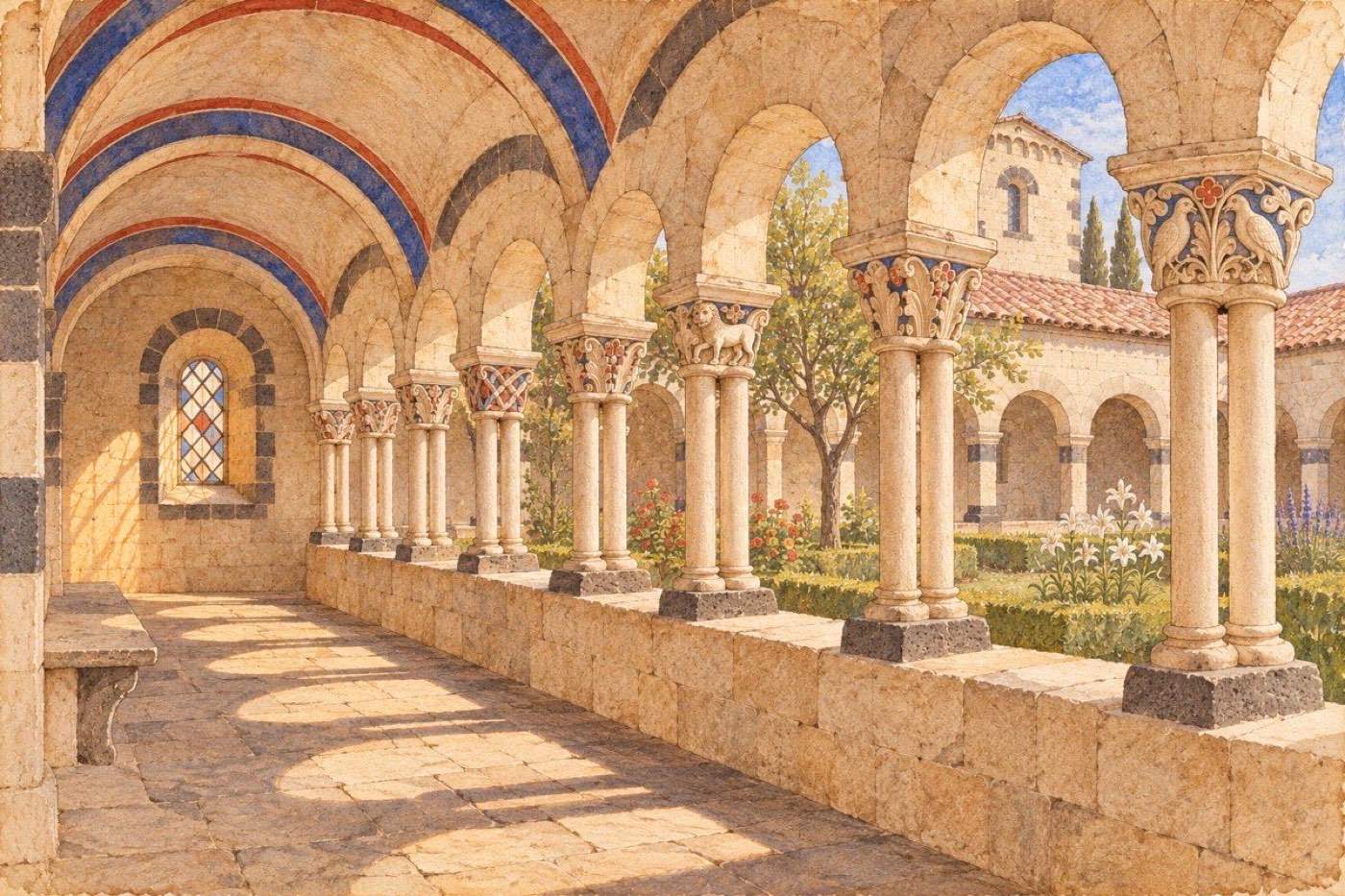
Gothic grew out of Romanesque. The Abbey of Saint-Denis near Paris, whose choir was rebuilt between 1140 and 1144, is considered the first Gothic building.
Three on stone, one on a region, two on ink. Each follows one question from start to finish.
Folio 01
What is a priory, who leads it and how it differs from an abbey: conventual and dependent priories, the Cluniac model and what makes a church a priory church.
Read the guideFolio 02
Romanesque architecture characteristics explained: thick walls, round arches, barrel and groin vaults, the church floor plan, portals with carved tympana and interiors.
Read the guideFolio 03
Romanesque vs Gothic architecture: round vs pointed arches, walls vs buttresses, small vs large windows, which came first and where the change began in France.
Read the guideFolio 04
Three Romanesque priories of the Forez in the Loire: the hilltop priory of Saint-Romain-le-Puy, the fortified priory of Champdieu and the priory of Pommiers-en-Forez.
Read the guideFolio 05
The history of Western calligraphy: uncial and half uncial, the monastery scriptorium, Carolingian minuscule, blackletter, italic and the modern revival.
Read the guideFolio 06
What Carolingian minuscule is, where it came from, its main advantage, how a medieval scriptorium worked and why our typefaces descend from it.
Read the guideThe Forez is a former province of France in the central part of today's Loire department, with Montbrison as its historical capital. Several Romanesque priories still stand on its hills and plain.